A practical look at casino stays, facilities and nearby accommodation, with a focus on what property details and booking terms can verify.
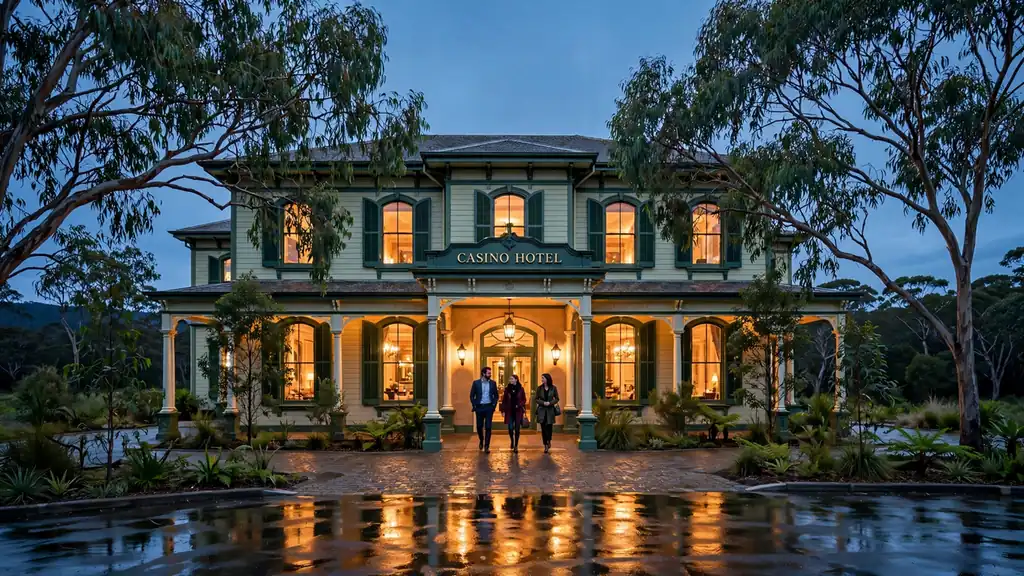
A casino hotel combines two separate purchases: a room and access to a property that also has gaming facilities. The room booking is the part that can be compared on price and terms. A casino’s presence does not establish that accommodation is available, that a particular room type is offered, or that a stay includes any gaming benefit. Those details need to be confirmed for the named property and dates before a booking is treated as an offer.
A headline rate is not the final amount unless the booking terms show that it is. The useful comparison is the payable total for the same dates, room category and number of guests, with taxes and mandatory charges included. Where a rate is shown per night, the full stay cost should be calculated before comparing it with another option. A lower displayed rate can lose its advantage once required charges are added.
The cancellation rule changes the value of a deal. A non-refundable booking may have a lower price, but that saving is also the cost of giving up flexibility. A refundable rate should be assessed against its cancellation deadline and any conditions attached to a change. If the terms are unclear, the price cannot be compared on equal footing: one figure may buy flexibility while the other does not.
Other details to verify include whether breakfast is included, whether payment is taken at booking or later, and whether the room description lists the facilities that matter for the stay. These are not automatic features of a casino hotel package. A promotion should be treated as a set of written conditions, not as a promise implied by the word “deal”.
Room names alone are a weak basis for comparison. The description should make clear what is included in the room, the bed arrangement and any restrictions that could affect the booking. If a particular view, access arrangement or room feature is important, it should appear in the confirmed booking details rather than only in a general property description.
The same distinction applies to packages. A hotel offer may bundle accommodation with another service, but the bundle is only financially useful if each included item is wanted and its terms are clear. A stated package value is not a saving unless the room price and the actual value of the extras can be compared with buying them separately. Any condition tied to dates, availability, payment or cancellation changes the effective offer.
Before payment, the confirmation should match the selected dates, room type, guest details and total shown at checkout. The booking channel should also be clear about who handles amendments or disputes: the property or a third-party seller. A low price does not resolve uncertainty about which party is responsible for a change.
Opening information can be easy to misread because a hotel and a casino may operate on different schedules. A hotel’s check-in and check-out times are not the same as the hours of a gaming floor, and neither can be inferred from a general property listing. A late arrival, early departure or planned visit therefore needs separate confirmation from the relevant official information.
Hours can also change, so an old listing or an undated third-party page is a poor basis for arranging a stay. The exact property should be identified first, then its current accommodation terms and any separate venue schedule checked directly. If those details are not published clearly, confirmation from the property is more reliable than assuming that hotel access and casino access follow the same timetable.
For a Tasmania casino hotel, the practical decision is therefore not whether a package sounds generous. It is whether the room, total cost, cancellation terms and relevant hours are stated clearly enough to calculate what the booking actually provides.
A search for poker at a Tasmanian casino can refer to several different things: a dedicated poker room, a table game, a scheduled tournament or simply a general gaming area. Those are not interchangeable. A venue’s general casino description does not establish that it has a separate poker room, runs tournaments or offers a particular format. Each facility and session needs confirmation from current venue information before travel is planned around it.
A venue’s general casino description does not establish that it has a separate poker room, runs tournaments or offers a particular format.
A poker room is a specific on-site playing area; a tournament is an organised event with its own entry conditions and schedule. Neither should be assumed from the other. Tournament details can change, and a past event listing does not establish that another session is running now. Where an event is advertised, the useful details are its date, registration arrangements, format, entry cost, eligibility rules and any stated late-entry conditions. If those terms are not published, the practical value of the listing is limited.
The word “rooms” is ambiguous in this context. It may mean hotel accommodation, which is a separate matter, or it may describe gaming rooms within a casino. A room label alone does not identify the games available, whether poker is included, or whether the area is open to all visitors. Facility names should therefore be read alongside a current description, rather than treated as proof of a particular service.
The same distinction applies to a poker room listing. It does not establish that cash games are running at the time of arrival, that a tournament is scheduled, or that seats are available. A useful venue page should separate permanent facilities from dated events and state any conditions that affect access. If it gives only a broad casino description, it cannot answer those narrower questions.
For poker machine gambling, venues must check identification. Legal age and entry requirements should be confirmed with the venue before play; ignoring an applicable requirement can carry legal consequences. Poker tables and Electronic Gaming Machines (EGMs) are different forms of gaming, so information about one should not be taken as a statement about the other. A poker tournament listing does not, by itself, explain the rules or access conditions for EGMs.
“Open now” and “open today” are time-sensitive questions, not reliable descriptions of a venue’s regular facilities. Current opening information should come from the venue’s own published channels or direct contact, with any temporary changes checked close to the planned visit. A general listing may be outdated, and an open casino does not necessarily mean that every gaming area, table or event is operating.
The same caution applies to a casino sports bar. A bar is a separate amenity from a poker room; its existence, operating hours and screening arrangements cannot be inferred from the casino label. Venue information should identify the facility and its current service details before it is treated as available. A sports bar mention does not confirm live sport coverage, and a casino’s gaming information does not establish bar access.
For a planned poker visit, the decision can be reduced to verifiable conditions: the specific facility is identified, the relevant session is dated, access requirements are stated and the information is current. Without those points, a search result is a lead, not a booking plan. That is a modest distinction, but it prevents a venue name or old event notice from being mistaken for a confirmed seat.
Legal Requirements
Venues must check identification for poker machine gambling; ignoring legal age and entry requirements can carry legal consequences.
Parking, bingo and dining are practical parts of planning a casino visit, but a search term does not establish that a particular service is available at a Tasmanian venue. Parking arrangements, including whether valet parking or complimentary parking is offered, need to be confirmed with the venue before travel. Conditions can differ by location and may change, so an old listing or a general description is not a reliable basis for calculating the cost or timing of a visit.
The same applies to bingo and dining. A casino-related bingo listing does not, by itself, confirm that bingo is currently scheduled or that entry is open to the public. Dining references also need to be checked against the venue’s current information; a search for casino dining in Tasmania is not evidence of a particular restaurant, menu or service. These are separate decisions from choosing where to stay or comparing on-site facilities.
A casino in Tasmania is a physical venue, while an online casino is a different service with a different legal position. Under the Interactive Gambling Act 2001, operators based in Australia cannot offer real-money online casino games to people in the country. That restriction covers games such as pokies, blackjack and roulette. The distinction matters: an online result using a Tasmanian location does not make the service a locally authorised casino.
 Best Casino in Victoria: Hotel Details and LimitsLearn what can and cannot be confirmed about Victoria casino hotels, including room terms, offers and facilities. General search phrases are not…
 Perth Casino Guide: Stays, Dining and Visit PlanningCompare casino-hotel stays with nearby accommodation, check booking terms, and explore dining, events, poker, jobs and limits on online pokie claims.
Offshore websites sit outside Australian regulation. Australian law does not regulate those platforms as domestic casino providers, even though the legislation’s operator restrictions are directed at supplying prohibited services to people in Australia. This is not equivalent to local oversight or a local avenue for resolving a dispute. A website’s own claims about its status do not change that position.
Consequently, “online casino” and “casino in Tasmania” should not be treated as interchangeable descriptions. The first may lead to an offshore service; the second refers to a venue that must be assessed through its own current visitor information. No ranking or promotional label can replace that distinction.
For a venue visit, confirm parking terms directly with the casino, including whether parking is available and whether any charge or access condition applies. Check bingo schedules and dining details through current venue channels rather than assuming that a listing reflects today’s arrangements. That keeps the decision tied to information that can actually affect the trip.
For online play, the relevant issue is not whether a site accepts an Australian address, but whether the service is lawfully offered and subject to Australian oversight. Offshore operators are not regulated under Australian law. Their terms, complaint processes and payment arrangements are not substitutes for domestic regulation, and access to a website does not establish that it is authorised to provide online casino games locally.
Gambling outcomes are uncertain; losses should not be chased by increasing bets. A session budget based on available funds sets a boundary, not a forecast of returns. If the budget is exhausted, stopping is the only calculation that prevents further gambling from increasing the loss.
A stay near a Tasmanian casino is a separate decision from booking a room inside the venue. The useful comparison is between the accommodation’s total cost and the practical journey to the casino location, not the distance suggested by a listing title. “Nearby” can describe a short walk, a drive or simply the same area; the description alone does not establish which.
Start with the exact venue name and its current address, then compare accommodation against that point on a map. Check the route as well as the straight-line distance. A property can look close on a map while requiring a longer trip by road or on foot. Travel time may also vary with transport availability and the time of the visit, so a location claim should be checked against a current route rather than treated as a fixed guarantee.
For each property, compare the full booking price for the intended dates and the same occupancy. A lower headline rate may not be the lower final cost if required charges, cancellation conditions or transport expenses differ. Record whether the quoted rate is refundable, when payment is due and what happens if plans change. These terms determine the real cost of flexibility; “deal” is only a label until those conditions are counted.
Accommodation promotions should be assessed in the same way. Check the dates when an offer can be used, any minimum-stay requirement, what is included and whether the price changes at checkout. A package tied to a casino visit is not automatically better value than booking the room and transport separately. Compare like with like, and do not assign a monetary value to an inclusion that would not otherwise be purchased.
 Adelaide Casino: Hotel Stays, Dining and Venue GuideSeparate casino access from nearby accommodation, compare room rates by total cost and inclusions, and assess related venue searches.
 Best Casino in Melbourne: Hotel and Visit GuideCompare on-site room rates and booking terms, and check what to verify for parking, dining, facilities, events and nearby accommodation.
Parking can affect the comparison even when the accommodation is not on casino premises. Confirm whether parking is available at the property, whether it is included in the rate and whether its conditions suit the planned arrival. Then check parking arrangements at the venue separately. A listing’s proximity does not establish that parking is available, free or suitable for a particular vehicle.
Searches for casino opening times, trading hours and gaming machines concern the venue rather than nearby lodging. Those details can change and should be verified through the venue’s current information before travel. The same applies to any claim that a property is partnered with the casino or provides a particular transfer service: a booking description is not proof unless the terms set out the arrangement.
A practical comparison can be kept to four entries: the final accommodation price, the cancellation terms, the route to the venue and any parking or transport cost. This makes accommodation near a Tasmanian casino comparable without assuming that the closest listing is the best value. It also separates a genuine saving from a promotion whose conditions remove the apparent advantage.
Contact information is useful only when it can be matched to the right venue and purpose. A general enquiry line may not handle bookings, lost property, accessibility questions or event ticket issues. The practical check is to use the contact channel published by the venue itself, then confirm that it relates to the relevant department. Details copied into older directories or event listings can be out of date.
Sensitive payment or identity information should not be sent through an unverified address or an unsolicited message.
A telephone number should be checked against the venue’s current official page before it is used. The same applies to email addresses, enquiry forms and listed service hours. If a call concerns a booking or a specific event, retaining the booking reference and the date of the visit makes it easier to identify the transaction. Sensitive payment or identity information should not be sent through an unverified address or an unsolicited message.
A bar search does not establish that a particular bar is open, that it serves a specific menu, or that walk-ins are accepted. Hours, entry conditions and service arrangements can differ by venue and may change around private functions or scheduled events. The venue’s own current information is the relevant reference; an old review is not confirmation of today’s service.
A car park search has the same limitation. A map pin can show an address without confirming whether parking is on site, available to visitors, accessible at a particular time or subject to a fee. Before setting out, the venue’s access and parking information should be checked alongside the route. Where parking arrangements are unclear, the venue can confirm whether an alternative drop-off or public transport option is available.
A map should also be read as a navigation aid rather than a guarantee about entrances. Large properties may have separate access points for the main venue, accommodation, events or deliveries. The address and entrance instructions should be matched to the intended destination, particularly when an event ticket names a room or function space.
Concert listings require a distinction between an event being advertised and tickets being available. Dates, start times, age conditions, entry rules and cancellation arrangements belong to the event’s current ticketing information. Third-party listings may help identify an event, but the venue or authorised ticket seller is the place to verify the terms before travel or payment.
Searches about baccarat or craps do not confirm that either game is offered at a particular Tasmanian venue. Table games and their operating arrangements can vary, so availability should be confirmed directly through official venue information rather than inferred from a general casino description. A name appearing in an old listing is not proof of a current table or session.
For any enquiry, the useful record is the venue contacted, the department reached, the time of confirmation and any reference supplied. That leaves a clear trail if event or access arrangements change. It is a modest administrative step; relying on an unverified map label is less precise.
Breakfast and buffet information is time-sensitive, so a general description of a Tasmanian casino is not enough to establish what is served, when service runs or whether a meal is included with a stay. A breakfast offer may be tied to a room booking, a particular rate or a limited period; a buffet listing may describe a separate service rather than breakfast. Those distinctions affect the final cost and should be confirmed against the current venue or booking terms before treating an advertised package as comparable.
Comparing Offers
Identify components
Separate the room price, meal inclusion, and booking conditions.
Verify eligibility
Check if the breakfast offer applies to every guest on the selected dates.
Confirm service details
Verify the specific service name and meal period for any mentioned buffet.
Calculate final cost
Determine the total price including any charges for changing or cancelling the booking.
For a useful comparison, separate the components: room price, meal inclusion, booking conditions and any charge for changing or cancelling. If breakfast is included, check whether the offer applies to every guest covered by the booking and whether it is available on the dates selected. If a buffet is mentioned, confirm the service name and meal period rather than assuming that “buffet” means breakfast. A headline rate without those conditions is not a complete price.
The word “resort” also needs a precise reading. It may be used in a property description, a package name or promotional wording; it does not, by itself, establish which facilities are available or what a stay includes. A resort offer should be assessed as a bundle of stated inclusions and exclusions. If the value depends on meals, credits or other benefits, each item needs a usable condition and a clear price treatment. Anything not specified should not be counted as a saving.
Rewards programmes require the same arithmetic. A points balance or member offer has little financial value until the earning rules, eligible purchases, expiry conditions and redemption options are clear. A benefit restricted to selected dates or services is not equivalent to a general discount. Nor should a reward be treated as cash unless its terms permit that use. Promotional language can make an offer sound larger than its practical value; the relevant figure is the amount actually saved on a booking that would otherwise have been made.
Gambling rewards should not be treated as a reason to raise stakes or extend a session. A session budget should be set from available discretionary funds, and losses should not be chased by increasing bets. The expected value of a meal or stay does not alter the outcome of gambling.
Interest in casino jobs in Tasmania calls for a separate check from guest offers. An employment listing should identify the employer, position, location, duties, employment status and pay basis. The written terms matter more than a broad description of the workplace: hours, penalty arrangements, leave, training requirements and any conditions attached to the role determine what the position is worth in practice.
A job title alone does not establish the actual duties or schedule. Applications should be assessed against the formal description and the employment offer, with particular attention to whether stated hours are guaranteed or variable and whether advertised pay includes allowances. No vacancy should be assumed current merely because an old listing remains visible. The decisive details are the application closing date, if stated, and confirmation that the employer is still accepting applications.
Breakfast packages, rewards and job advertisements are different propositions, but each benefits from the same test: identify the condition, the period it applies to and the value that remains after exclusions. Without those terms, a headline is not a reliable basis for comparing offers or employment.
Opening status is a date-sensitive detail, not a permanent feature of a venue. A casino’s regular operating schedule may differ from the hours applying on a public holiday, during maintenance or while an event is being staged. Any decision that depends on a particular visit should be based on the venue’s current official operating information, checked close to the intended date. An old listing can remain visible after its details have changed; that is not confirmation that the doors will be open.
An old listing can remain visible after its details have changed; this is not confirmation that the doors will be open.
The same distinction matters for reports about a casino reopening. A proposed reopening, development announcement or planning discussion does not establish that a venue has resumed operation. The useful evidence is an explicit current notice giving an operational status and, where applicable, a confirmed date. Until that appears, “planned” and “open” belong in different columns.
Entertainment calendars can change independently of a venue’s usual schedule. An advertised performance or special event should be checked for its date, venue, entry conditions and any notice of cancellation or rescheduling. A listing without a current date cannot establish that entertainment is available during a particular stay. Nor does a general reference to entertainment confirm that a specific event is taking place.
For budgeting, event information has practical value only when the terms are clear. A ticket price, booking condition or entry requirement should be treated as part of the cost of attending, not as an incidental detail. Where a listing does not state those terms, the total cost cannot be calculated from the listing alone.
Development can affect access, facilities or the timing of operations, but an announcement is not proof that construction has begun or that a project is complete. The status should be described using the language of the latest formal update: proposed, approved, under way or completed. Those stages are not interchangeable. A development page that has not been updated may describe an earlier plan rather than the present position.
Employment information is also time-sensitive. A general statement that a venue may employ staff is not evidence of a current vacancy, role conditions or a closing date. Those details require a live recruitment notice. Development announcements may mention future opportunities, but they should not be read as a hiring commitment unless vacancies and application terms are actually published.
A menu can change with the venue’s operating arrangements, so a saved copy or third-party listing may not reflect what is currently offered. The relevant version is the one published by the venue for the applicable location and date. Menu details are best assessed separately from opening and event information, since one listing does not verify the other.
A casino review is most useful when it separates confirmed operating details from impressions. Claims about current hours, events or development should be traceable to dated information; opinions about atmosphere cannot establish those facts. For a 2026 decision, recency is part of the evidence: an accurate account of a past opening schedule is still a poor guide to the present one.
Choosing an online casino from Tasmania calls for a careful look at the information available for each option. This list offers a concise reference point, including stated licensing details and practical payment information where provided.
LevelUp Casino
LevelUp Casino lists a Curacao eGaming licence held by Dama N.V. Its stated minimum deposit is A$15.
Vegaz Casino
Vegaz Casino lists a Curacao licence, OGL/2024/1335/0780. Its stated minimum deposit is EUR 20.
GoldenCrown
GoldenCrown lists a Curacao Gaming Control Board licence, OGL/2023/176/0095, held by Hollycorn N.V.
Golden Pokies
Golden Pokies is listed with a Curacao licence; no further operator details are provided here.
SpinsUp
SpinsUp lists a Curacao Gaming Control Board licence, OGL/2023/174/0082, held by Dama N.V.
SkyCrown
SkyCrown lists a Tobique Gaming Commission licence. Its stated payout times are around 10–15 minutes for crypto and 1–5 days for fiat, with a minimum deposit of A$30.
Roby Casino
Roby Casino lists a Curacao eGaming licence held by Roby Games Ltd.
MrPacho
MrPacho lists crypto payout times of 30–120 minutes and fiat payout times of 24–72 hours. Its stated minimum deposit is A$30.
Neospin
Neospin lists a Curacao Gaming Control Board licence, OGL/2023/176/0095, held by Hollycorn N.V.
Bizzo Casino
Bizzo Casino lists a Curacao Gaming Control Board licence held by TechSolutions Group N.V.
A restaurant listing associated with a Tasmanian casino is not, by itself, evidence that the venue is currently open or located inside the casino. Results can combine on-site dining, nearby businesses and older pages. The useful distinction is location first, then current operating information: a restaurant inside the property, one elsewhere in the complex, and an independent restaurant nearby are different options, even when all are described as casino dining.
Before treating a listing as actionable, check that its information comes from the venue or casino’s own current channels. A menu image on an old directory page may no longer reflect the dishes, prices or service arrangements. A current menu, opening notice or reservation page provides a stronger basis for planning. If those details cannot be confirmed, the listing should be treated as an indication of a possible venue, not a confirmed meal option.
Price is best assessed from the menu itself. Compare the listed price with the full order being considered, including any stated supplements or service conditions. A headline dish price is not a complete meal cost if additional items are needed. Where the menu gives no clear price or conditions, the total remains uncertain; promotional language does not resolve that uncertainty.
"At the casino" may refer to a venue within the property, while "near the casino" can mean a separate business in the surrounding area, affecting travel time and booking management.
Restaurant descriptions also need to be read literally. “At the casino” may refer to a venue within the property, while “near the casino” can mean a separate business in the surrounding area. This matters for travel time, entry arrangements and whether a booking is handled by the casino or by an independent operator. A map pin or directory category alone may not settle the distinction, so the address and booking contact should match the restaurant’s own information.
Menus are not interchangeable across venues or service periods. Cuisine labels and photographs give only a broad impression; the current menu is the relevant document for checking dishes, prices and dietary notes. Dietary suitability should not be inferred from a dish name or a general claim about the restaurant. Where an ingredient or preparation method matters, written menu details or a direct confirmation from the venue are more useful than an undated summary.
Booking terms affect the practical value of a dining option. Confirm whether a reservation is required, whether the booking is for the restaurant itself, and what cancellation or arrival conditions apply. A casino’s general contact page may not provide restaurant-specific answers, particularly where dining is run by a separate business. The responsible contact is the one identified on the current restaurant page.
For Tasmania casino restaurants, the decision can therefore be reduced to verifiable items: exact location, current service status, menu, prices, booking route and any stated conditions. If one of these is missing, the uncertainty belongs in the comparison rather than being replaced with an assumption. A polished listing is presentation; a current menu and clear booking terms are the useful part.
A spa, a bar or a particular dress code should not be treated as part of a casino simply because it appears alongside the venue’s name. Amenities and entry policies can differ between properties and change over time. Before making plans, confirm each detail through the venue’s current official information rather than relying on a third-party listing.
An address is useful only when it identifies the intended property and entrance. Tasmania-related casino listings can be confused with hotels, entertainment venues or other businesses, so the venue name should be checked alongside the street address. Confirm the location against the operator’s own directions before setting off, especially where a listing does not clarify which entrance serves the casino.
A map pin is not proof that a particular entrance, facility or service is available to visitors.
The same check applies to practical details such as access arrangements. A map pin is not proof that a particular entrance, facility or service is available to visitors. If the destination is unclear, the venue’s official contact channel is the sounder source than an old directory entry.
A search for a casino day spa may refer to a spa at a nearby hotel or resort rather than a facility inside the casino. The distinction matters when travel time or a booking depends on the service being on site. Check the named provider, location and current service details before treating a spa as part of a casino visit.
Bar listings also need property-level confirmation. A mention of a bar does not establish its current hours, access rules or whether it is within the gaming venue. Dress expectations can vary by area and occasion; where a venue publishes an entry policy, that policy takes precedence over assumptions based on casino dress codes elsewhere. No general rule should be inferred for every Tasmanian property.
Venue gaming information should be checked directly, including any conditions applying to Electronic Gaming Machines (EGMs). Identification checks may apply to poker machine gambling, and ignoring a venue’s legal requirements can have consequences. Gambling is not a way to cover rent or grocery costs; that expectation is an illusion. A session budget should be set from available discretionary funds, and bets should not be increased to recover losses.
Online casino games are a separate matter. Under the Interactive Gambling Act 2001, operators cannot provide real-money casino games, including pokies, to people located in Australia. A venue’s games information should not be read as an invitation to use an offshore online casino.
Career searches are best assessed through the operator’s own recruitment information. A general careers page may describe the kinds of roles a business employs without showing that a particular vacancy is open. Confirm the employer, role, location and application conditions before relying on a listing; a search result alone is not evidence of a current position.
Food and pool facilities are separate practical questions, not proof that a casino has either amenity. A venue’s name or casino status does not establish that it operates a food court, serves meals on site or provides a swimming pool. Those details need confirmation from current venue information before they are treated as part of a visit.
Food-related information is most useful when it identifies the actual service: whether food is available at the venue, what type of offering it is and when it operates. A food court is a specific format, not a synonym for a restaurant, café or bar. If the available listing does not identify a food court, its existence should not be assumed. Menus, service hours and access conditions can also change, so older third-party descriptions are not a reliable basis for planning.
Pool searches require the same distinction between a casino and a broader resort or hotel complex. A pool may be associated with accommodation rather than the gaming venue, and a nearby facility is not necessarily open to casino visitors. Any listing should make clear which property provides the amenity and whether access is included, restricted or separately arranged. Without that detail, “casino pool” is only a label, not a confirmed facility.
For Tasmania, a comparison should separate verified on-site amenities from nearby alternatives. Useful evidence is a current venue page or direct confirmation that names the facility and explains access. Where that confirmation is unavailable, the accurate entry is “not confirmed,” rather than a confident claim based on a photograph, old review or broad resort description. That distinction matters: an amenity can affect travel plans, but an unverified listing cannot settle whether it will be available on arrival.
Yes. The Interactive Gambling Act restricts Australian-based operators from offering online casino games such as pokies, blackjack and roulette to people in Australia. Offshore sites are not regulated under Australian law, although it is technically not illegal for Australian players to use them.
Offshore casinos are not regulated under Australian law, but it is technically not illegal for Australian players to use them. In NSW, players must be at least 18 to gamble on poker machines, and mandatory pre-commitment systems require players to set a loss limit before playing.
Region blocking uses a player’s IP address to identify their location and prevent access to games or providers restricted in that region. Blocked games may not appear in the lobby or may fail to load.
Examples include progressive jackpot pokies, which add a small share of each bet to a growing jackpot, and buy-bonus pokies, which let players pay to enter a bonus round directly.
You must be 18 or older to gamble on poker machines in NSW.