Live dealers use physical casino equipment, while RNG-based games rely on software to select card deals or roulette results.
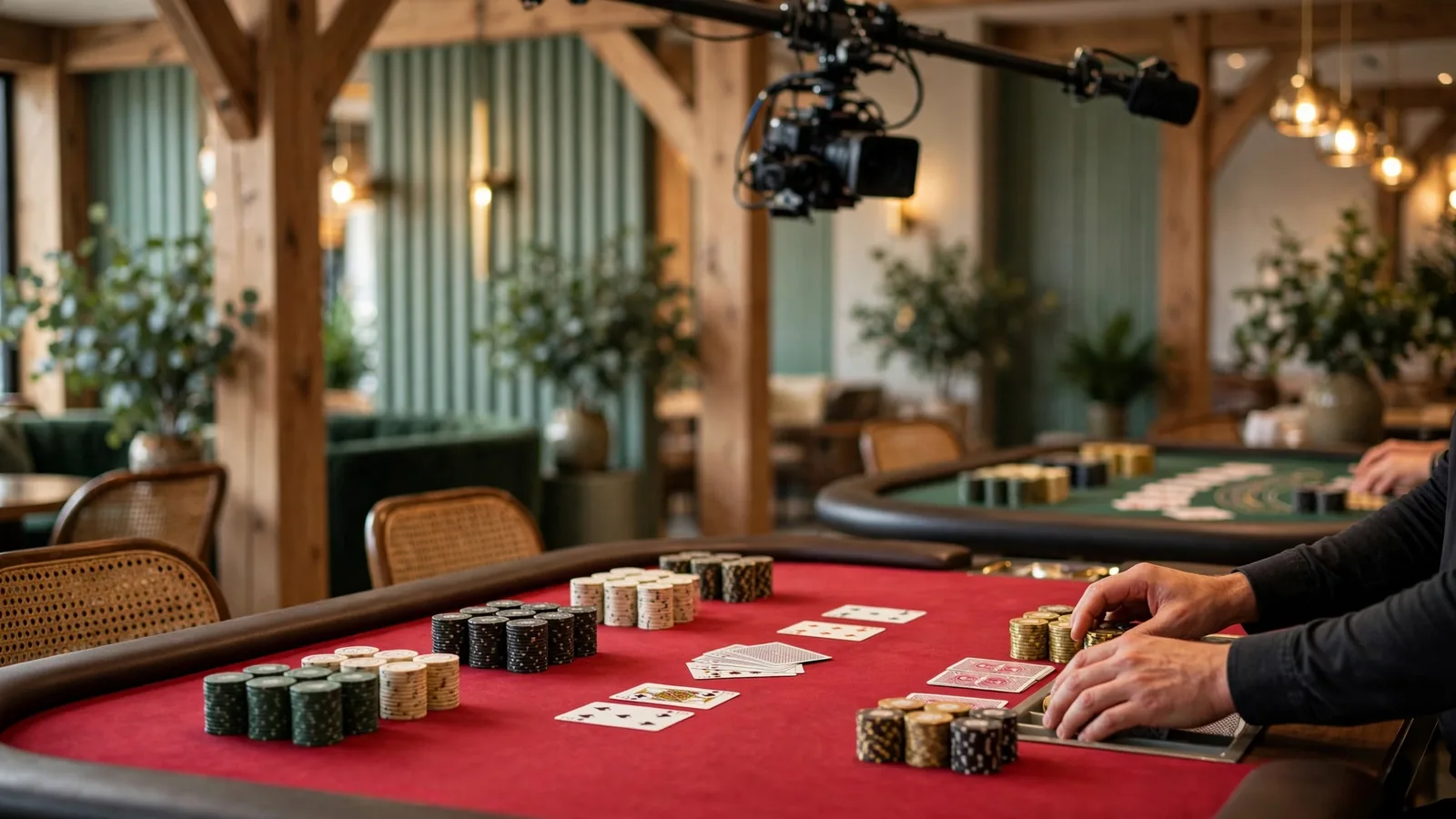
An online table game can present its result through one of two mechanisms: a live dealer operating real casino equipment, or software using a Random Number Generator (RNG). The difference is in how the outcome is produced, not merely how the screen looks. A streamed table shows a real dealer and equipment in action; an RNG-based version has software determine the outcome.
In a live-dealer format, a real dealer conducts the game using casino equipment, and video of the process is streamed to players. The visible action is therefore connected to a physical table rather than being an animation generated to represent a deal or wheel result. The dealer and equipment provide the setting in which the outcome occurs, while the stream carries that activity to the screen.
In an RNG-based format, there is no streamed physical table determining the result. The software’s random number generator selects the outcome. For a card game, that means determining which cards are dealt; for roulette, it determines where the ball lands. Graphics can show cards, a wheel or other table imagery, but the visual presentation does not itself establish the result. The RNG does.
Choosing a real-money casino for table games in Australia means checking practical details as well as the operator’s stated licensing information. This guide highlights the specific details available for each entry.
LevelUp Casino
LevelUp Casino lists a Curacao eGaming licence held by Dama N.V. Its minimum deposit is A$15.
Vegaz Casino
Vegaz Casino lists a Curacao licence, OGL/2024/1335/0780. Its minimum deposit is EUR 20.
GoldenCrown
GoldenCrown lists a Curacao Gaming Control Board licence, OGL/2023/176/0095, held by Hollycorn N.V.
Golden Pokies
Golden Pokies is listed with a Curacao licence.
SpinsUp
SpinsUp lists a Curacao Gaming Control Board licence, OGL/2023/174/0082, held by Dama N.V.
SkyCrown
SkyCrown lists a Tobique Gaming Commission licence and a minimum deposit of A$30. Its stated payout times are around 10–15 minutes for crypto and 1–5 days for fiat.
Roby Casino
Roby Casino lists a Curacao eGaming licence held by Roby Games Ltd.
MrPacho
MrPacho’s stated minimum deposit is A$30. Its payout times are 30–120 minutes for crypto and 24–72 hours for fiat.
Neospin
Neospin lists a Curacao Gaming Control Board licence, OGL/2023/176/0095, held by Hollycorn N.V.
Bizzo Casino
Bizzo Casino lists a Curacao Gaming Control Board licence held by TechSolutions Group N.V.
That distinction matters when interpreting what is on screen. A rendered wheel may look like a physical wheel, but in an online software version the landing place is selected by the RNG. Likewise, a digital deal may resemble cards being distributed across a table, while the underlying outcome is determined by the generator. In a live-dealer stream, by contrast, the game is shown through video of a real dealer using real equipment.
The two formats can therefore have similar surface features without sharing the same outcome process. Both may display a table layout and present a result to the player. One shows live activity involving a dealer and casino equipment; the other uses software to determine the result and then displays it. Treating those formats as interchangeable because their screens look alike confuses presentation with mechanism.
This also explains why a label such as “live” describes more than visual style. In a live-dealer game, the stream shows the dealer and equipment involved in the game. In an RNG-based version, imagery may depict a dealer or table, but that imagery does not turn the software-generated outcome into a live one. The relevant question is what determines the deal or landing position, not whether the interface includes realistic graphics.
For someone comparing descriptions of online casino table games, the practical distinction is thus a question of process. A live stream transmits activity at a real table. An online software version uses an RNG to select the outcome represented on screen. Neither description, by itself, establishes anything about the quality of the stream, the software’s design, or the terms attached to a service; those are separate matters.
The word “online” can obscure this difference because it identifies how the game is accessed, not how its result is generated. Online play may refer to a live video feed or to an electronic game whose result is selected by software. A description that states only that a table game is available online leaves the mechanism unspecified. The terms “live dealer” and “RNG-based” identify the two distinct processes described here.
For card-based games, the RNG-based mechanism concerns which cards are dealt. For roulette, it concerns the ball’s landing place. Those examples show the same basic point in different settings: software determines the outcome in the online version, while a live-dealer format uses a real dealer and real casino equipment shown by video stream. The screen may provide the interface in both cases, but the source of the result differs.
This is a description of mechanics, not a recommendation or an assurance about any service. In Australia, the Interactive Gambling Act 2001 prohibits operators from providing real-money online casino games to people located in the country. The distinction between a stream and an RNG explains how outcomes are produced; it does not change that legal restriction.
Bitcoin table games combine two separate functions: a payment method and a game system. Bitcoin concerns how value is transferred; it does not determine which cards are dealt or where a roulette ball lands. Those outcomes in online table games are generated by a Random Number Generator (RNG).
Bitcoin is a payment method for transferring value and does not determine game outcomes, which are generated by a Random Number Generator (RNG).
That distinction matters when comparing bitcoin casino table games with table games that use another payment method. Changing the payment method does not, by itself, change the process that produces an outcome. In an online card game, the RNG determines the cards dealt. In online roulette, it determines the ball’s landing position. The payment choice sits outside those decisions.
A useful way to understand the setup is to separate the transaction from the game event. A transaction concerns the movement of funds. A game event concerns the outcome generated by the software. Treating them as one feature can make a payment option seem as though it changes the game, when the relevant mechanism is the RNG.
The same distinction applies to searches for BTC casino table games, casino table games for Bitcoin, or the best Bitcoin casino table games. “Bitcoin” identifies a payment-related interest; it does not identify a different ruleset or a special way for the game to produce results. The word “best” also does not follow from the payment method. Bitcoin alone establishes no ranking of table games and no basis for calling one a better choice.
Nor does comparing Bitcoin table games with “normal” casino table games establish a mechanical difference. If both are online versions, the stated outcome mechanism is the RNG. The payment method does not turn an RNG-based game into a live-dealer game, or vice versa. Those are distinctions about how the game is presented and operated, not about whether funds are transferred using Bitcoin.
This separation also limits what can responsibly be inferred from a payment label. It does not establish how a particular transaction is handled, what charges might apply, how quickly funds move, or what account conditions may exist. Those matters concern payment and service terms. They should not be treated as evidence about how the game determines its outcomes.
The phrase “table top” can refer to the physical table or felt associated with casino games, but an online game’s display is not the physical surface. A streamed table and a software-based table may look different; neither appearance makes Bitcoin part of the outcome process. For an online RNG game, the defining mechanical point remains that software selects the result.
This is not a claim that every site offering a Bitcoin payment option provides the same games or terms. It is narrower: the payment method itself does not alter the described outcome mechanism. A bitcoin-labelled table game remains an online table game, and its cards or roulette result are still determined by the relevant game system.
For Australian readers, payment terminology should not be confused with permission to provide a service. The Interactive Gambling Act 2001 prohibits operators from offering real-money online casino games to people in Australia. A payment method does not change that legal framework, just as it does not change an RNG’s function.
Bitcoin, then, answers a question about payment—not how an online table-game result is generated. The game mechanics and payment arrangements are separate matters; one does not establish the features of the other.
Legal Restriction
Under the Interactive Gambling Act 2001, it is prohibited for operators to provide real-money online casino games to people located in Australia.
An online table-game result can be determined by a Random Number Generator (RNG). It may select the cards dealt or determine where a roulette ball lands. That describes how an outcome is produced; it does not, by itself, show how often a player can expect a particular result or how a game compares with another.
This distinction matters when considering claims about the best odds at casino table games. A random process can generate outcomes without favouring a particular player, but that alone does not establish whether the terms of one game are more favourable than those of another. The RNG is part of the outcome mechanism, not a scorecard for comparing games.
Odds comparisons need a defined basis. The game’s rules and the relationship between possible outcomes and payouts affect what a stated chance means in practice. Without those details, a label such as “best odds” has no precise meaning. It may refer to the likelihood of a specific outcome, the amount paid when it occurs, or an overall measure of expected returns. Those are different comparisons, not interchangeable descriptions.
The same limit applies to a casino table games house edge chart. A chart can only be meaningful when its figures correspond to specified rules and conditions. A general statement that online outcomes are generated by an RNG does not supply those figures, and it cannot support a reliable ordering of games from most favourable to least favourable. A precise-looking ranking without a clear basis is presentation, not analysis.
The RNG statement applies to online card outcomes and roulette results, but it does not establish comparative probabilities, payout terms or an overall advantage. Those measures require evidence beyond the fact that outcomes are generated randomly.
Randomness should also not be confused with predictability. Knowing that an RNG determines a result does not reveal what the next card will be or where a roulette ball will land. Nor does it provide a basis for treating previous results as a dependable guide to a future one. The mechanism explains selection; it does not turn a sequence of results into a forecast.
Accordingly, broad claims about casino table games with the best odds need more than a description of online randomness. A defensible comparison would have to state what is being measured and under what rules. Without that distinction, “best” and “worst” are unsupported labels. The sound conclusion is narrower: an RNG determines certain online outcomes, while that fact alone does not rank table games by odds.
Table games do not all define a result in the same way. In a dealer-versus-player hand, the central comparison is between two hand values. In a dice game, the wager concerns the outcome of a pair of dice. Those structures determine what a round is about; they do not, by themselves, establish the likelihood of a particular result or the value of a wager.
In Blackjack, the player’s hand is compared with the dealer’s. The objective is to finish with a hand value closer to 21 than the dealer’s hand. The result therefore depends on a relative comparison: neither hand is assessed in isolation, because the relevant question is which one is nearer to the stated target.
This distinction matters when describing the game. “Getting closer to 21” is not the same as simply reaching 21, and the objective is not framed as building the strongest hand across a table of competing players. The dealer is the opponent in the comparison. The player’s result is understood in relation to the dealer’s hand.
A basic explanation of Blackjack can therefore be kept to three elements: there are two sides to compare, each side has a hand value, and 21 is the reference point. That describes the objective without adding a particular rule for how a round must proceed. The comparison also explains why the same hand cannot be assessed as a result on its own: its significance depends on the dealer’s hand.
A dice table game has a different structure. Players roll a pair of dice and bet on the outcome. The wager is attached to what happens with the dice, rather than to whether one hand is closer to 21 than another.
That is the useful distinction for understanding the format. In the hand-based contest, the result is a comparison between player and dealer. In the dice-based format, the result is connected to a roll and the outcome on which a bet has been placed. The mechanics are simple to state at this level, but they should not be stretched into a full ruleset: the particular outcomes available for betting depend on the game’s stated rules.
A table’s rules determine what a wager refers to and how the result is settled. Without those rules, “betting on the outcome” does not specify which outcomes are covered or how any particular bet is resolved. Naming a dice game would not remove that need; the relevant terms still have to define the available bets.
These examples show why a table-game explanation needs to identify the object of the wager before discussing a result. Blackjack centres on the relative values of the dealer’s and player’s hands, with 21 as the target reference. The dice format centres on a pair of dice and a bet tied to its outcome. They are different ways of organising a round, not interchangeable descriptions of one mechanic.
That account describes what each game asks its participants to compare or predict. It does not rank games, imply that one is easier to understand, or establish which wager is more favourable. Those are separate questions from the basic mechanics—and the mechanics alone do not answer them.
Australia’s online casino rules are set by the Interactive Gambling Act 2001 (IGA). For real-money casino games, the central distinction is not whether a service advertises table games or where its website is hosted. The law prohibits operators from providing these services to people located in Australia.
Technical access to a website does not establish that its service is permitted under Australian law, as ACMA may block unlicensed platforms.
Section 5 of the IGA bars operators based in Australia from offering real-money interactive casino games to residents. The restriction covers online casino-style services, including table games. An Australian business cannot make such a service lawful simply by describing it as entertainment or placing it on a website.
The prohibition also applies to offshore operators serving people in Australia. A foreign address or licence does not create an exception to the Australian restriction. The relevant issue is that the service is being provided to someone physically in the country. This is why the rules cannot be reduced to a distinction between local casinos and overseas websites: the law concerns the provision of the gambling service to Australians, not merely the operator’s registered location.
The Australian Communications and Media Authority (ACMA) is responsible for enforcing compliance. Its enforcement role includes blocking access to unlicensed platforms. A website appearing online, or loading at a particular time, therefore does not establish that its service is permitted under Australian law. Availability and legality are separate questions; technical access is not a regulatory approval.
The framework also matters when a search concerns table games at a casino nearby. The wording of a search does not alter the legal status of online play, and a table-game label does not place an online casino outside the IGA. The rule applies to the service itself, rather than to the name used for a game or the way a site presents it. Physical venues are a separate subject from online casino services.
The law is directed at operators providing prohibited services. The stated maximum daily penalties are A$360,000 for individuals and A$1.8 million for corporations that violate the IGA. Those amounts indicate the scale of potential operator enforcement; they are not a fee for accessing a game and should not be read as a penalty imposed on a player for playing at an offshore site.
For Australian residents, the practical legal position is therefore restrictive: real-money online casino games are not a lawful service for operators to provide to people in the country, whether the operator is based locally or offshore. ACMA enforcement, including blocking, is part of that framework. A game’s availability online does not change the rule, and neither a table-game category nor an overseas location removes the service from the scope of Australian law.
A casino table game is a game presented around a table-based format, whether its play is shown through a live video feed or handled by software. Online, the key distinction is how the game is presented and how its outcomes are produced: a live dealer operates real casino equipment on camera, while a software-based version uses a Random Number Generator (RNG).
In a live-dealer game, a real dealer and physical casino equipment form part of the play. A camera feed is streamed to players, so the screen shows events taking place at the table rather than a wholly software-generated representation. The dealer and equipment are real; the online connection carries the live video to remote viewers.
An RNG-based online table game does not depend on a streamed dealer to determine the result. Software generates the outcome. For a card game, that means the RNG determines which cards are dealt; for roulette, it determines where the ball lands. The display may present a table and game elements on screen, but those visuals do not make the outcome a live event.
This distinction defines what people mean by online casino table games more usefully than the screen design alone. A digital table can appear realistic without showing a live dealer. Conversely, a streamed table may look like a conventional casino table because it is one, with a real dealer using real equipment. The deciding points are the presence of live equipment and video, or the use of software to generate the result.
The phrase “table game” therefore describes a broad format, not one particular set of rules or a guarantee about how a game is operated. It can refer to live-dealer play or to an online version resolved by an RNG. The category is not defined by whether the interface resembles felt, displays cards, or shows a wheel. Those are presentation details; the operating format is the more useful distinction.
Casino table-game software can refer to the software-based side of this divide, where an RNG determines outcomes and the interface displays them. That should not be confused with live-dealer streaming: in the latter, the video shows a dealer and equipment in operation. The two formats can both appear on a screen, but the screen does not erase the difference between a generated result and a live table event.
In Australia, this terminology describes formats, not permission to provide real-money play. An online presentation does not change the nature of the underlying service. Separating the format from the legal status keeps the definition precise: “online table game” identifies a way a casino-style game is presented and operated, not an endorsement or a statement that the service is locally authorised.
Online table games fall into two broad formats: streamed play with a live dealer, and software-based play in which a Random Number Generator (RNG) determines the outcome. The distinction is about how play is produced. A game’s table-style presentation does not, by itself, show which format is in use.
In a live-dealer format, a real dealer operates real casino equipment, and video of the game is streamed to players. The on-screen action comes from that live setting. The stream lets the game be viewed as it unfolds, rather than presenting an outcome generated solely by game software. For a broad description of casino live table games, this is the defining feature: a dealer and equipment are present, and their activity is transmitted as video.
Software-based online versions use an RNG to determine outcomes. In a card game, it determines which cards are dealt; in Roulette, it determines where the ball lands. The result is therefore generated by software rather than established by a live dealer’s equipment. A digital table or animated presentation does not change that mechanism.
A real dealer operates physical casino equipment, and the action is transmitted to players via a video stream.
A Random Number Generator (RNG) determines the outcome, which is then presented through a digital interface.
These formats can look similar at a glance because both may display a table, cards or a wheel. The useful distinction is not the screen design but the source of the outcome: live equipment captured in a stream, or an RNG operating within the online game. The same general table-game category can be presented through either format, so a list of casino table games would not necessarily identify how each version works.
The distinction also sets limits on what can be inferred from appearance. A video stream indicates that a live dealer and real casino equipment are involved; a software-rendered table may show the game interface, but its outcome is determined by the RNG. The screen alone should not be treated as evidence that an online version uses a physical table.
Terms such as “live table games” describe the streamed format, not a guarantee about the range of games available. Likewise, calling a product an online table game does not establish whether its outcomes come from streamed equipment or software. Those details depend on the format of the particular version.
This is a practical way to read descriptions of table-based online play without treating presentation as mechanics. Live play has a real dealer and equipment behind the stream; software-based play has outcomes selected by an RNG. Neither format label supplies a catalogue, a ranking, or a measure of odds. It identifies how the game is delivered and how its result is produced.
Card-based table games can organise play around competing hands, but the wager does not have to be placed on the player’s own hand. One stated format allows bets on the player’s hand, the Banker’s hand or a tie. These are distinct outcomes: the wager identifies which side or result is being backed, while the cards determine what happens at the table.
That distinction matters when reading a betting layout. A bet on the player’s hand is not the same selection as a bet on the Banker’s hand, and neither is identical to choosing a tie. The available choices describe the possible result being selected; they do not, by themselves, establish how a particular game settles a wager or what return it pays. Those details depend on the rules attached to the specific game and bet.
Blackjack uses a different comparison. The player competes against the dealer, with the aim of finishing with a hand value closer to 21. The central reference point is therefore the value of each hand in relation to that target, rather than a choice among the player, Banker and tie outcomes. Both formats involve cards, but their betting structures should not be treated as interchangeable.
For a card table, the useful first distinction is between the hand being evaluated and the result selected by the wager. In blackjack, the stated objective concerns the player’s hand in competition with the dealer’s. In the other described betting structure, a player may select either hand or a tie. Knowing which structure applies is necessary to understand what a bet refers to; it does not establish which selection is more likely to win.
The names of the betting options also should not be mistaken for a complete ruleset. A label such as “Banker” identifies one of the available sides in that format, while “tie” identifies a separate possible result. The labels alone do not specify card values, dealing procedures, settlement rules or payouts. Those are game-specific terms and must be read as such rather than inferred from the names.
This keeps the comparison precise: blackjack is described by its dealer-versus-player objective, while the alternative card-betting format is described by the available choices of player hand, Banker’s hand or tie. The shared feature is card-based play; the decision structure is not the same. No conclusion about odds or returns follows from these mechanics alone.
Online roulette is available in several versions, with European, French and American formats among the main variants. Their most clearly stated distinction is the arrangement of numbered positions and green zero positions. That detail defines what is visible on the wheel layout; it does not, by itself, establish which version offers better odds.
The European and French layouts each contain thirty-six numbered positions alongside a green zero. The American layout also includes the green zero, but adds a second green position marked double zero. In practical terms, the visible difference is one additional marked position in the American format.
These distinctions matter when identifying which roulette rules apply to a particular online table. A label such as “roulette” alone does not specify the variant: the format name and the wheel layout are relevant. The number of green positions is a straightforward feature to check in the displayed table information, rather than an assumption to make from the game’s general name.
The layouts also provide a narrow way to compare different casino table games without treating them as interchangeable. That is separate from card-based table games, where the relevant structure concerns hands, or dice games, where the outcome is tied to a roll.
A free-play version, where available, would not alter the meaning of these layout terms: European and French refer to the one-zero arrangement, while American refers to the layout with both zero and double zero. The presence of a promotion or a rental setting does not change those variant definitions either. The wheel layout remains the point of distinction, not the payment arrangement or promotional label attached to a table.
For a rules description to be precise, it should name the variant rather than rely on a broad reference to roulette. The layout then identifies whether the table displays a single green zero or an additional double-zero position.
Poker is a contest centred on making the strongest possible hand. That objective distinguishes it from table games where the stated focus is a direct contest against a dealer or a wager on a particular outcome. In poker, the hand itself is central: players compete over which hand is best.
The phrase “poker table games” can cover different formats, but the shared description is limited to that broad aim. It does not establish the rules of a particular format, how hands are formed, or how a winner is determined when hands are compared. Those details depend on the game’s rules and should not be assumed from the word “poker” alone.
This matters when a casino labels a table as poker. The category indicates a hand-building contest, not a complete explanation of the game. A name that includes “poker” does not, by itself, confirm that its rules match another poker format. Nor does the general objective support a ranking of casino poker table games or a conclusion that one version is preferable.
The core idea remains straightforward: participants seek to build the best possible poker hand. Beyond that, claims about hand rankings, betting structure, specific variants, or comparative chances require rules for the particular game. The broad objective supplies no basis for filling in those details.
Poker’s appeal as a table-game category rests on that competitive hand objective. It is a concise description, not a substitute for a game’s rules.