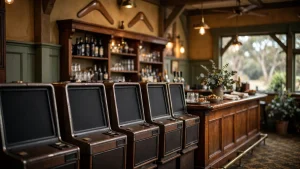
“Pokies parlour” is informal wording; a casino’s licence depends on the state or territory where it operates.

“Pokies parlour” is a colloquial phrase, not a precise description of a particular Australian venue. It can suggest a physical gaming room, a casino, or simply a business using familiar gambling language in its name or advertising. The wording alone does not identify the venue’s operator, location, licence or facilities. Those details have to be established separately.
In a physical setting, the useful distinction is between a casino and the broader category of gaming venues. A casino is a property operating under a licence issued by the state or territory where it is located. Australia’s casino industry is regulated at that jurisdictional level, rather than through a single national casino licence. The term “parlour” does not replace or describe that licensing arrangement. It is a label, not evidence of a venue’s regulatory status.
That distinction matters because a phrase such as “pokie parlour casino” may combine informal wording with a formal venue type, without making the result clearer. A casino can have gaming areas, while “parlour” may be used loosely in descriptions of gaming spaces. But the phrase does not establish that a place is a casino, that it has a particular number of gaming machines, or that its facilities match any specific description. A name can suggest an atmosphere; it cannot do the work of a licence record.
Choosing a pokies parlour casino in Australia is easier when you can check the available operator details before exploring further. This list offers a concise reference to the information provided for each option.
LevelUp Casino
LevelUp Casino lists a Curaçao eGaming licence held by Dama N.V. Its minimum deposit is A$15.
Vegaz Casino
Vegaz Casino lists a Curaçao licence. Its minimum deposit is EUR 20.
GoldenCrown
GoldenCrown lists a Curaçao Gaming Control Board licence held by Hollycorn N.V.
Golden Pokies
Golden Pokies lists Curaçao as its licensing jurisdiction.
SpinsUp
SpinsUp lists a Curaçao Gaming Control Board licence held by Dama N.V.
SkyCrown
SkyCrown lists a Tobique Gaming Commission licence. Its stated payout timing is around 10–15 minutes for crypto and 1–5 days for fiat; the minimum deposit is A$30.
Roby Casino
Roby Casino lists a Curaçao eGaming licence held by Roby Games Ltd.
MrPacho
MrPacho lists payout timing of 30–120 minutes for crypto and 24–72 hours for fiat. Its minimum deposit is A$30.
Neospin
Neospin lists a Curaçao Gaming Control Board licence held by Hollycorn N.V.
Bizzo Casino
Bizzo Casino lists a Curaçao Gaming Control Board licence associated with TechSolutions Group N.V.
The same caution applies when the wording appears on a website. A site using “parlour” or “casino” in its branding is not thereby a physical casino, nor does its terminology establish that it holds an Australian casino licence. The phrase may be chosen for its familiarity rather than its accuracy. In that sense, “pokies parlour” is a poor identifier: it points towards a general kind of gambling experience but does not settle what is actually being offered or by whom.
The national picture needs similar care. A specialist review has counted more than 20 full-scale casinos across Australia’s eight states. That is a source-specific count, not a permanent definition of the market: properties, classifications and licence arrangements can change. It should not be treated as a complete, timeless census simply because the number is stated precisely. The underlying regulatory structure is more dependable: individual casino properties operate under licences granted by their own state or territory.
A separate measure gives another view of scale. The total number of gaming machines installed in Australian casinos and endorsed on their venue licences is 3,308. That figure concerns machines in casinos, not every machine in every kind of Australian gaming venue. It also does not mean that each casino has the same number, or that a parlour-style label can be used to infer a venue’s machine count. The licence endorsement and the physical installation are the relevant measures; the wording on a sign is not.
 Best Pokies in Melbourne: Returns, Venues and HoursLearn how RNGs and theoretical RTP differ from session results, and what can be verified about Melbourne venues, opening hours and legal…
 Big Red Pokies Online in Australia: What’s VerifiedLearn why the “Big Red” label alone does not confirm a game’s identity, provider, features or availability in Australia.
For anyone interpreting a venue description, three questions keep the terms from getting blurred: is the place a physical property, is it identified as a casino, and which state or territory has issued its licence? “Pokies parlour” answers none of those on its own. It may be a convenient colloquial description, but it is not a national category that overrides local regulation or tells the full story of a venue.
The phrase can therefore be useful as a broad pointer to gaming-related premises, but it is not a reliable classification. A physical casino is defined by its licensed status and location within the state or territory framework. A parlour-style label is only wording until those details are established. The distinction is not semantic bookkeeping: it separates a descriptive phrase from the facts that identify an actual venue.
Major Australian casinos operate around the clock, so entry is not limited to a daytime session. Continuous opening does not mean every part of a property follows identical access arrangements; the casino floor, restaurants and other facilities may have separate conditions. A “VIP” label, where used for a parlour or area, should therefore be treated as a description of the offer or space, not as evidence of different legal entry rules.
The minimum age for casino entry is 18 across Australia. This applies nationally, rather than depending on whether a venue uses “parlour” or “VIP” in its branding. Being accompanied by an adult does not change the stated minimum age for entering a casino.
Valid photo identification is required for entry to all major Australian casinos. It is a practical condition of admission, not an optional check reserved for first-time visitors. The requirement also means that a booking, membership or invitation does not replace identity verification at the door.
Hours, age and identification answer different questions. A property may be open at any hour, but that does not make entry available to someone below the minimum age or without acceptable photo ID. Likewise, a VIP designation does not itself establish eligibility, guarantee access or identify what documents will be accepted. Any additional conditions attached to a particular area or event need to be assessed separately from the general entry requirements.
The useful baseline is simple: major casinos operate 24 hours a day, entry is restricted to adults aged 18 or over, and valid photo ID is required. These conditions describe physical casino access. They do not establish that a similarly branded online service has the same status or can be entered on the same terms.
Australia’s gambling map is uneven: a count of cities with gambling facilities is not the same as a count of casinos, and neither measure indicates how many venues a city has. A specialist gambling review gives a national tally of 147 cities with gambling. That figure describes the review’s coverage, rather than a permanent register of every place where gambling is available.
 Canberra pokies: hours, locations and what is verifiedLearn why venue opening hours do not confirm gaming-machine hours, and why location, returns and payment claims need separate verification.
 Best Casino in Melbourne: Hotel and Visit GuideCompare on-site room rates and booking terms, and check what to verify for parking, dining, facilities, events and nearby accommodation.
The same review identifies Sydney, in New South Wales, as the country’s largest gambling city, counting 11 gambling facilities there. The figure is a city-level total, not a count of casinos alone. It therefore should not be used to infer that Sydney has 11 casinos, or that it has more casinos than every other Australian city. The distinction matters: broad facility counts can combine different kinds of gambling venue, while a casino count refers to a narrower category.
That concentration also does not make the national picture uniform. Gambling facilities appear across cities in multiple jurisdictions, while casino properties operate under licences issued by their respective state or territory. A city tally can help describe geographic reach, but it does not replace property-level or jurisdiction-level information. Nor does a large facility count establish that every venue has the same operating model.
The Northern Territory provides a more specific example of how a regional count can be presented. A specialist review reports three casinos across three cities in the territory. In that same review’s count, Alice Springs has the highest number of casinos among Northern Territory cities: one. Here “highest” is a relative description within the territory, not a claim that Alice Springs has a large concentration in absolute terms. One casino is still one casino.
Identified as the country's largest gambling city with a count of 11 gambling facilities.
Contains three casinos distributed across three different cities.
Holds the highest number of casinos among Northern Territory cities, with one venue.
These figures should be read at their stated scale. The national city tally concerns places with gambling; the Sydney figure concerns facilities; the Northern Territory figure concerns casinos and cities; and the Alice Springs figure compares casino counts between cities in that territory. Substituting one category for another produces a misleading map. A list of gambling cities cannot establish the number of casino properties, and a casino total cannot show how many other types of gambling facility are present.
For anyone comparing Australian locations, jurisdiction and venue type are the useful starting points. State and territory licensing means that the national picture is assembled from local systems rather than a single uniform venue network. Counts attributed to a specialist review are best treated as that review’s snapshot, not as an official, timeless ranking. The geography is informative; the labels attached to each count determine what it actually measures.
A venue name is more useful when it is tied to a place that can be located. In Australia, the term “parlour” in a description does not itself identify a physical address. Lasseters Casino, for instance, is at 93 Barrett Drive in Alice Springs, Northern Territory, with the postcode 0870. The address gives a street, locality and postal detail rather than relying on a broad label such as “pokies parlour”.
Country Club Casino has a different location reference: Country Club Avenue, Prospect, within Meander Valley. That description places the venue in the Prospect area and identifies the surrounding local government area.
 Best Pokies in Perth: What Can Be VerifiedLearn why a venue’s opening hours may not confirm that pokies are operating, and what Perth location, online-play and payment searches can…
 Best pokies in Brisbane: what to checkCompare Brisbane pokies claims with care: the same game can use different RTP settings at different casinos, so a title alone cannot…
These two named venues illustrate why address wording matters. A full street address and a locality-level listing do not offer the same degree of precision. In the first case, Barrett Drive and the postcode accompany Alice Springs; in the second, Country Club Avenue is paired with Prospect and Meander Valley.
The name alone is not a substitute for the address. “Pokies parlour” may describe the kind of place someone has in mind, but it does not establish where a venue is situated or whether a particular business uses that wording. For a physical visit, the relevant information is the named venue and its stated location: Lasseters Casino on Barrett Drive in Alice Springs, or Country Club Casino on Country Club Avenue in Prospect, Meander Valley.
A site loading in a browser is a technical result, not a licensing decision. The same applies when a page accepts account traffic or appears at a different web address. None of those conditions establishes that an online casino is authorised to serve people in Australia.
The legal distinction is material. Under the Interactive Gambling Act 2001, operators are prohibited from providing real-money online casino games to people physically located in Australia. That prohibition covers casino-style offerings such as slots, poker and table games. A service’s branding, claims about its location or use of an offshore domain does not change the Australian rule.
A functioning page may show that a particular address is reachable at a particular time. It does not show that the operator holds an Australian authorisation, that the service complies with federal law or that the address will remain available. An alternate domain is still only an address; it is not a licence.
Legal Prohibition
Under the Interactive Gambling Act 2001, operators are prohibited from providing real-money online casino games to people physically located in Australia.
This matters where a site presents itself as a place to play online, including through parlour-style language. The phrase “pokies parlour” does not establish that a digital service is connected to a licensed physical venue, or that online play is permitted. Nor does a free-play label establish the legal status of the service. The relevant question is what the operator provides to people in Australia, not how the page describes itself.
The Australian Communications and Media Authority (ACMA) is the federal body responsible for enforcing the Interactive Gambling Act 2001 and monitoring compliance with federal interactive gambling laws. It can investigate services that provide or advertise prohibited online gambling, and it can request that Australian internet service providers block access to websites offering prohibited services or advertising them in Australia.
Website blocking can affect whether a domain resolves through an Australian internet service provider. A site that was reachable may later be blocked, while an operator may appear under another address. That change does not amount to a regulatory approval or a reversal of the underlying law. It changes the route to the page, not the status of the service.
ACMA’s enforcement record includes blocking more than 1,455 illegal gambling and affiliate websites since November 2019. Reports of services withdrawing from the Australian market since enforcement began in 2017 do not give a single consistent total: one account puts the number above 210, while another says more than 190.
A blocked address is therefore not the only relevant sign of enforcement, and an unblocked one is not evidence of permission. Availability can vary with domain changes and internet-provider blocking. Neither a working link nor a failed one answers the licensing question.
The practical distinction is between access and legal status. Access describes whether a website can be reached; legal status concerns whether the service may be provided to people in Australia. Treating those as interchangeable turns a technical observation into a regulatory claim it cannot support. The same applies to a new domain, a registration page or a page that continues to accept account traffic: each can be present without demonstrating Australian authorisation.
A useful review separates what can be checked from what is merely asserted. The name “pokies parlour” may appear on a page, but branding alone does not establish what service is being offered or whether its claims are reliable. The same applies to polished descriptions, promotional graphics and confident labels such as “trusted” or “official”: none is evidence of operating conditions.
A review should identify the subject precisely. A physical gaming venue and a website using parlour-style language are different things, and a review that moves between them without saying so is difficult to assess. For a venue, concrete details such as its location can be checked against the place being described. For an online service, a working page or account interface establishes only that the page loaded at that moment. It does not establish the service’s status under Australian law.
The wording of a review also matters. Statements about access, account features or customer support should be presented as observations with a clear basis, not as guarantees. A claim that a site is available because it opens on one connection is especially weak: access can vary by domain and internet service provider. Reviews that treat availability as proof of legitimacy confuse a technical result with a regulatory one.
Domain changes create another problem. Website blocking can stop particular addresses from resolving through Australian internet service providers, while an operator or related party may later use a different address. A new address does not, by itself, show that the underlying service has changed, been approved or become lawful. Nor does a blocked address alone explain every reason a page may fail to load. A review should therefore distinguish an observed access issue from a conclusion about the service.
A specialist review has reported ACMA blocking action involving illegal gambling services and alternate domains associated with Fair Go. That history is relevant to claims about changing web addresses, but it should not be turned into an endorsement of a replacement link. ACMA’s enforcement role is not a verification badge for any domain that remains reachable. A review that directs readers to alternate addresses as a way around blocking is not evaluating the service neutrally; it is helping route around an enforcement measure.
For a “pokies parlour casino” review, the central test is consistency. Does the page identify whether it is discussing a physical venue or an online service? Are factual claims separated from opinion? Does it explain what was actually checked, and avoid treating branding, availability or a changed domain as proof? If those distinctions are absent, the review offers little usable evidence, however definite its verdict sounds.
A reliable assessment also avoids filling gaps with assurance. Words such as “safe,” “licensed” or “approved” require substantiation, not repetition from the service’s own materials. Where a review cannot show the basis for such a description, the label contributes no measurable information. That is a simple accounting problem: a claim without supporting evidence has no verifiable value.
A sign-up bonus and a no-deposit bonus describe different claims, but neither label establishes that an offer is lawful, available or worth a stated amount. In Australia, the distinction matters before any calculation begins: the Interactive Gambling Act 2001 prohibits operators from providing real-money online casino games to people in the country. A promotional label does not change the nature of the underlying service.
A sign-up offer generally suggests a benefit linked to opening an account. “No deposit” suggests that the benefit can be claimed without first funding that account. Those descriptions are not complete terms. They do not establish whether the benefit is cash, restricted promotional credit or something that can only be used under conditions. Nor do they establish whether a balance can be withdrawn, what has to happen first, or whether the offer is available to a particular person.
Bonus Distinction A sign-up bonus is generally linked to account opening, while a no-deposit bonus suggests benefits can be claimed without first funding the account.
That gap between a headline and its conditions is where the apparent value can change. A displayed amount, if one is claimed, is not automatically money received or money withdrawable. Its practical value depends on the rules attached to it and on whether those rules can be met. Without the full terms, a meaningful net-value calculation cannot be made. A large-looking figure is still only a figure on a page until its conditions and outcome are clear.
For a sign-up claim, the relevant accounting questions would include what event triggers eligibility, whether the benefit is granted automatically or requires a separate action, and what happens if an account does not meet the stated conditions. The wording would also need to distinguish the promotional balance from any funds belonging to the account holder. If those categories are blended together, the headline can overstate what is actually available.
A no-deposit claim needs the same scrutiny, with an additional point: the phrase describes the absence of an initial payment, not the absence of conditions. A claim could still be restricted by eligibility rules, account requirements or limits on how the benefit may be used. “Free” does not supply those details. It says nothing by itself about whether a balance can be converted into withdrawable funds or whether some further action is required.
The calculation should therefore separate three things: the advertised benefit, the conditions attached to it, and the amount that can ultimately be retained. If any of those cannot be established, the final value cannot be established either. That is not a technical distinction. It is the difference between a promotional number and an outcome that affects a person’s money.
The legal setting puts a further limit on how such claims should be interpreted. Online casino-style games, including slots, poker and table games, are prohibited interactive gambling services when provided to customers in Australia. The Act places obligations on operators; it does not turn a bonus label into evidence that an online casino is permitted to serve Australians. Nor does a promotion become lawful because it is described as a welcome benefit, a reward or a no-deposit offer.
This is also why a bonus should not be treated as proof of a legitimate Australian casino product. A working account flow or a promotional page cannot establish that the underlying online service is authorised. The relevant distinction is between a physical casino operating under a state or territory licence and an online service offering casino-style games to people in Australia. Promotional language does not bridge that distinction.
The practical test is documentary rather than emotional: the terms must define eligibility, the nature of the benefit, any conditions on use, and what can be withdrawn. If those elements are unclear, the value is indeterminate. If the offer concerns real-money online casino play for people in Australia, the legal prohibition is more fundamental than the advertised amount. A no-deposit label cannot remove it, and a sign-up label cannot make the service lawful.
“Free chips” and “free spins” describe promotional language, not a verified benefit. The wording alone does not establish who qualifies, what activity the offer covers, whether the credit can be used, or whether any resulting balance can be withdrawn. A claim has practical value only when its conditions and the service providing it are clear.
Attention A "free" label does not establish a cash value or guarantee that a balance is withdrawable without meeting specific conditions.
The distinction between a physical casino and an online service matters. Australian casinos operate under licences issued by their respective state or territory jurisdictions. That fact does not extend a casino’s licence to a website using similar branding, nor does a physical venue’s existence prove that an online promotion is available under Australian law.
For online offers, the label “free” does not change the legal character of the activity. The Interactive Gambling Act 2001 prohibits operators from providing real-money online casino games to people in Australia. Casino-style games, including poker and other table games, are treated as prohibited interactive gambling services when supplied to customers here. A promotional credit or free-play feature cannot, by its name alone, establish an exception.
A separate check concerns whether the advertised benefit is actually defined. A usable offer would need to specify the eligible service and account, the qualifying action, any restrictions on using the credit, and how any resulting balance is treated. Without those terms, “free” is a headline, not a cash value. A displayed balance is not necessarily withdrawable funds, and a stated spin or chip allocation does not establish what can be retained after play.
The same caution applies when a claim is attached to a physical venue. A casino’s local licence and operating status describe the venue; they do not confirm a particular free-play promotion. The offer itself would need to be attributable to that venue and set out in conditions that can be checked. Branding that combines a parlour-style name with casino language does not resolve whether the claim concerns a physical property or an online service.
ACMA’s role is relevant where online services are involved. The Australian Communications and Media Authority enforces federal interactive gambling laws and can ask internet service providers to block access to websites supplying prohibited services or advertising them in Australia. It has blocked more than 1,455 illegal gambling and affiliate websites since enforcement actions began in November 2019. Blocking can also affect whether a particular domain resolves, while alternate addresses may appear over time. A working address is therefore not proof of lawful status, and a blocked address does not make a replacement domain legitimate.
The practical test for a free-chip or free-spin claim is consequently narrow: identify the service, establish whether it is a physical venue or an online casino-style offering, and inspect the actual conditions rather than treating the promotional label as value. If the claim points to real-money online casino play for people in Australia, “free” does not make that service permissible.
A bonus headline is not a cash figure. Its value depends on what the terms allow, what conditions attach to it and what remains usable after those conditions are applied. “Bonus” is a label; the relevant measure is the net value under the stated rules.
A sound assessment separates the advertised amount from the amount that can actually be retained or withdrawn. Restrictions on eligible games, withdrawal conditions, expiry and account eligibility can all reduce practical value. If a condition cannot be translated into a clear consequence, the headline figure cannot carry the calculation. Attractive wording does not repair an unclear term.
The comparison also needs a consistent basis. A claim tied to a deposit, a claim described as a credit, and a claim presented as a reward are not automatically equivalent. Their value depends on the rules governing use and release, not on the category name. Adding figures from different types of claim would produce a total that looks precise but says little about what is obtainable.
The same discipline applies to the word “free”. A reward may still carry conditions that affect whether it can be used or converted into a withdrawable balance. The accounting question is not whether the claim sounds costless; it is whether any obligation, restriction or forfeiture changes the final result. If the conditions are not clear, the result is not measurable.
For Australian audiences, a promotional claim cannot be separated from the legal status of the underlying service. The Interactive Gambling Act 2001 prohibits operators from providing real-money online casino games to people in Australia, including slots and table games. A bonus description does not alter that rule, and its presence does not establish that an online casino service is lawful.
That makes the final-value test narrower than a comparison of headline figures. The claim must have intelligible terms, and those terms must be assessed against the legal status of the service. Without both, a displayed amount is packaging rather than a reliable measure of value. No arithmetic can turn a prohibited service into a permitted one; it can only expose what a claim’s conditions do to its stated value.
A useful evaluation therefore records the headline separately from the conditions and the resulting net figure. Where the conditions prevent a definite result, the claim remains unquantified. That is not a minor drafting issue: it is the difference between a number that can support a decision and a number that merely attracts attention.
A real-money offer attached to the phrase “pokies parlour” does not, by itself, identify a lawful online service in Australia. The Interactive Gambling Act 2001 prohibits operators from providing real-money online casino games to people in Australia. That includes online slots, poker and table games such as blackjack and roulette. The legal position concerns the service being provided, not the wording used to describe it.
A physical casino and an online account are separate things. Facts about a venue, its licence or its gaming machines do not establish that an online site using similar branding is licensed to accept real-money casino play in Australia. Nor does a site’s accessibility, its ability to accept account traffic or its appearance at an alternate domain prove Australian licensing. A working page is a technical condition, not a legal credential.
The distinction matters when assessing claims about deposits, withdrawals or real-money access. Such claims may describe what a website says it offers, but they do not establish that the service may lawfully provide online casino games to people in Australia. The same applies to a familiar name, a polished account area or a changing web address: none changes the legal character of the service.
ACMA enforces federal interactive gambling rules and can take action against operators providing or advertising prohibited services. Offshore casino services are also subject to blocking measures, so an address that resolves at one point may not remain accessible through Australian internet providers. Neither access nor disappearance supplies evidence of a licence.
Accordingly, “real-money play” is not a neutral extension of information about Australian gaming venues. The relevant distinction is between land-based casino activity and online casino services, which Australian law prohibits operators from supplying to people in the country. No particular online service’s availability or licensing follows from the phrase “pokies parlour” alone.