The guide distinguishes poker machines from table poker and flags venue, hotel, dining and facility details that the available information does not verify.
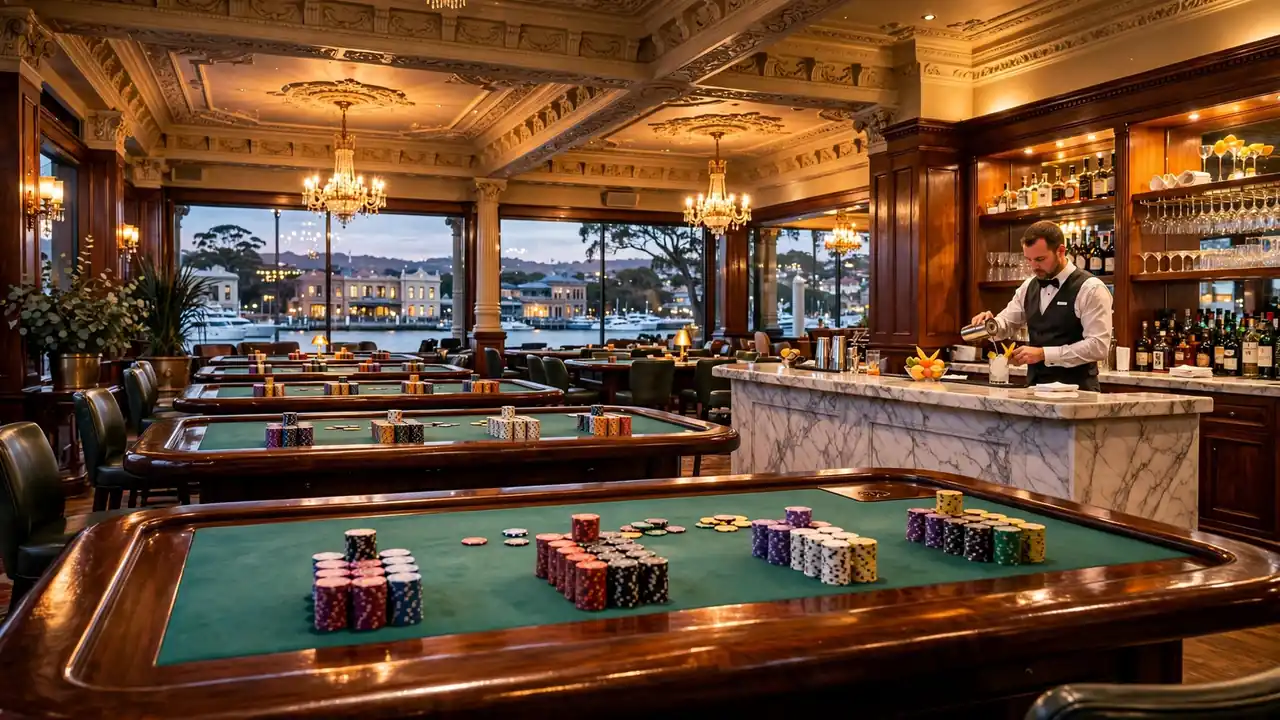
A poker room and a venue with poker machines are different facilities. Poker machines, known in Australia as Electronic Gaming Machines (EGMs), are individual gambling devices; they do not establish that a venue runs table poker, hosts tournaments or provides a dedicated poker room. Treating the terms as interchangeable can turn a general casino listing into an unsupported claim about a particular game.
A proper poker-room description would identify the game format, how tables operate and whether play is available on an ongoing basis or only during scheduled events. Tournament information would need to specify the event’s format, registration conditions and dates. Those details define the offer. Without them, a reference to “poker” does not tell anyone whether the subject is a live table game, a tournament, a machine game or merely a broad category on a venue page.
The same care applies to claims about a Hobart casino poker room. A venue name associated with gambling is not, by itself, evidence of a dedicated poker area. Nor does a general statement that a casino offers gaming establish that live poker is among its facilities. The distinction matters because a room, a table game and a tournament programme are separate things, each requiring its own description.
Choosing an online casino while searching for options in Hobart calls for checking the details that are available for each operator. This list offers a concise reference to help frame that choice.
LevelUp Casino
LevelUp Casino lists a Curacao eGaming licence held by Dama N.V. Its minimum deposit is A$15.
Vegaz Casino
Vegaz Casino lists a Curacao licence. Its minimum deposit is EUR 20.
GoldenCrown
GoldenCrown lists a Curacao Gaming Control Board licence held by Hollycorn N.V.
Golden Pokies
Golden Pokies lists Curacao as its licensing jurisdiction.
SpinsUp
SpinsUp lists a Curacao Gaming Control Board licence held by Dama N.V.
SkyCrown
SkyCrown lists a Tobique Gaming Commission licence. Its stated payout speed is around 10–15 minutes for crypto and 1–5 days for fiat; the minimum deposit is A$30.
Roby Casino
Roby Casino lists a Curacao eGaming licence held by Roby Games Ltd.
MrPacho
MrPacho lists crypto payouts in 30–120 minutes and fiat payouts in 24–72 hours. Its minimum deposit is A$30.
Neospin
Neospin lists a Curacao Gaming Control Board licence held by Hollycorn N.V.
Bizzo Casino
Bizzo Casino lists a Curacao Gaming Control Board licence held by TechSolutions Group N.V.
Tournament wording also needs precision. A tournament is not interchangeable with casual table play: it is an organised event with its own entry and playing conditions. A claim that tournaments are held regularly would require a schedule that supports the claim; a single event announcement would establish only that particular event, not a continuing programme. Dates and conditions can change, so old promotional material should not be treated as a current calendar.
A listing that uses the word “rooms” can be equally ambiguous. It may refer to a gaming area, a poker room, or accommodation; each describes a different facility. In a poker context, the useful question is whether the term specifically means a space for live poker, rather than a generic room within a venue. No assumption about accommodation follows from a poker-room label, and no assumption about poker follows from a general reference to rooms.
There is also a practical difference between a poker room and a sports bar. Both may be described as venue amenities, but one does not establish the other. A sports bar reference says nothing on its own about poker tables, while a poker listing does not confirm food service, screens or bar facilities. Combining these terms into one description can make a venue sound more fully equipped than the details actually support.
For anyone comparing poker options in Hobart, the relevant evidence is specific: a venue’s own current description of live poker, the form of play offered, and event information tied to identifiable dates and conditions. A tournament calendar should be read as a calendar, not as proof of daily play. A general gaming page should not be used to infer a poker room, and a poker reference should not be stretched into a claim about a bar or accommodation.
The standard is straightforward: distinguish the game from the machine, the room from the broader venue, and a scheduled tournament from ongoing play. On that basis, the phrase “poker at a Hobart casino” is not enough to describe a usable offer. Until a specific facility or event is identified with clear terms, the defensible description remains limited to the type of detail actually stated. A polished venue label is not a substitute for a game format, a date or operating conditions; in gambling, those are the parts that determine what is being offered.
Planning a stay near a casino depends first on knowing which venue and address the booking is meant to serve. The name alone is not enough to calculate a useful location: without a confirmed Hobart casino address, there is no reliable basis for comparing neighbourhoods, estimating travel time or describing any property as nearby.
Accommodation close to a casino is a location question, not proof that the venue operates a hotel. A separate lodging booking would need to be assessed on its own terms: the property’s address, room availability, total price, cancellation conditions and the route between the property and the intended destination. Those details should come from the accommodation provider, rather than being inferred from a casino name or a general city listing.
The same distinction applies to claims about Hobart casino accommodation deals. A price shown for a hotel is not necessarily a casino promotion, and a casino promotion does not establish that a room is included. Any package would need to identify what is being sold, who provides each component, the dates when it can be used and the conditions attached. Without those particulars, “deal” is a label, not a calculable saving.
For a practical comparison, the useful figure is the full cost of the stay, not just a headline nightly rate. The total can change with taxes, fees, meal inclusions, cancellation rules and payment conditions. A lower quoted price may have less value if it requires a non-refundable booking or excludes services expected elsewhere. These are property-specific terms, so they cannot be applied uniformly to accommodation in Hobart.
Location should also be checked against the actual itinerary. A property described as central, close to the waterfront or convenient for a casino may still require a separate journey, and those descriptions do not establish distance or travel time. Once a venue address is confirmed, a map can be used to compare routes and transport options; until then, proximity claims have no dependable reference point.
It is sensible to keep three questions separate: where the venue is, where lodging is available, and what the lodging costs under the chosen booking conditions. Combining them can make an ordinary accommodation listing look like an official casino arrangement. The booking confirmation should name the accommodation provider and state the address and applicable terms. Any casino-related benefit should appear explicitly in the offer, rather than being assumed from the property’s location.
Searches for a Hobart casino location, accommodation nearby and a stay package often appear together, but they require different evidence. A venue address supports route planning; a property listing supports an accommodation comparison; and a written package description supports a claim about a deal. None substitutes for the others. If any detail is unclear, the relevant operator should confirm it before payment.
This approach does not depend on assuming that the casino has a hotel or that nearby lodging is affiliated with it. It treats accommodation as a separate purchase whose value can be assessed from its own address, price and conditions. Until the destination and booking terms are established, a precise recommendation or a claimed saving would be guesswork rather than a useful travel calculation.
A casino hotel is more specific than a hotel located near a casino. The term implies that accommodation is part of the casino property or is operated in a clearly stated relationship with it. In Hobart, that distinction matters: proximity alone would not establish that a hotel is casino-operated, that casino access is included, or that a room booking comes with any venue benefit.
The phrase “casino hotel rooms” can also suggest a range of room categories, from standard accommodation to suites. Those labels should be treated as property-specific, not assumed from the word “casino”. A room description needs to identify the property and the actual features included. Without those details, claims about views, in-room facilities, access arrangements or premium room types cannot be relied on as descriptions of a Hobart casino hotel.
The same care applies to booking conditions. A hotel room and a casino promotion are separate products unless the offer explicitly connects them. Any package should state the dates covered, what the price includes, whether the room is refundable and whether additional conditions apply. A casino logo or a nearby address does not, on its own, turn a hotel booking into an official casino package.
For a Hobart casino hotel, useful evidence would include the property’s own description of its relationship to the casino, a bookable room listing and terms that explain what is included. The operator’s identity should be clear, too. If accommodation is run by another business, that fact affects who takes payment, handles changes and answers complaints. These are ordinary booking checks, but they prevent a convenient-sounding label from doing the work of a contract.
Room availability is also time-specific. A listing can change, and an old description may not match the current inventory or conditions. Details such as check-in arrangements, cancellation rules and included services should therefore be confirmed against the live booking terms before payment. A room name is not a guarantee of a particular view or amenity unless the terms say so.
There is a further distinction between being a guest at a hotel and being entitled to enter a casino. Accommodation does not itself establish access rights, and a casino visit does not establish that rooms are offered on site. Any claimed link between the two needs to be stated in the booking information rather than inferred from branding or location.
For a reader comparing a casino hotel in Hobart with other stays, the practical comparison is the total room price and the obligations attached to it—not the implied prestige of the label. A casino affiliation has value only where its terms specify a concrete inclusion. Until a named property publishes room inventory and conditions, claims about casino-operated rooms, room types or bundled benefits remain unsuitable as a basis for booking.
An online casino is not an extension of a Hobart venue. The legal position depends on where the player is physically located and where the service is operated, not on whether a website uses a local place name or presents itself as an Australian option.
The Interactive Gambling Act 2001 prohibits operators based in Australia from providing real-money online casino games to people in Australia. That restriction covers pokies, blackjack and roulette. A website describing itself as a Hobart casino does not alter the rule, and an online listing cannot establish that a local venue offers internet gambling.
Offshore platforms sit in a different, less settled position for players. It is technically not illegal for an Australian player to use one, but the platform is not regulated under Australian law. That distinction is narrower than it may sound: player use being technically lawful does not make the operator an authorised Australian provider, create local regulatory oversight, or guarantee a route for resolving a dispute.
Legal Warning
The Interactive Gambling Act 2001 prohibits Australian-based operators from providing real-money online casino games to people in Australia.
Geographic controls can also affect what appears online. Casinos and software providers may use an IP address to identify a player’s location and block access from excluded countries. A game withheld for an Australian location may not appear in the lobby; a game that is visible may still fail to load because of a regional restriction. Availability can therefore depend on the operator’s and provider’s rules as well as the applicable legal framework.
A specialist review has reported that some software providers have restricted games for Australian players in anticipation of possible future legal reforms. That is a report about provider decisions, not a fixed rule applying across the industry. Historical examples include NetEnt’s removal of its wide-area progressive jackpot games from Australia in 2016, including Mega Fortune and Hall of Gods, and region-blocking of NYX Gaming/Next Gen titles such as Foxin’ Wins and Doctor Love. Past availability does not establish present access.
A VPN can make an internet connection appear to come from another country, but using one to reach a region-blocked pokies site breaches the site’s terms and may result in account suspension. It does not change the player’s physical location or turn an offshore operator into an Australian-regulated service. A specialist review has also reported that a game may fail to load because of region blocking; changing the apparent location is not a dependable remedy.
The practical distinction is between a local venue and an offshore website. A Hobart address or venue name does not establish an online casino service, while an offshore platform’s accessibility does not establish Australian regulation. Any decision involving real money should account for that gap: the platform is outside Australian oversight, and the legal status of the operator is not repaired by a familiar label or a working website.
A baccarat listing, a bar description, parking information and a concert calendar are separate claims about a venue. For Hobart, none of these details is confirmed. A name attached to a casino search is not enough to establish that a facility or programme operates there, and a general venue description cannot substitute for current local information.
Baccarat and craps are table games, so their availability depends on the venue offering those games on site. The terms appearing in a listing or promotional description do not establish that either game is available in Hobart, or that tables operate at particular times. A reliable confirmation would need to identify the venue and state what is offered; without that, neither game should be treated as a confirmed Hobart facility.
The same distinction applies to a casino bar. A bar may be part of some casino venues, but that does not establish one at a Hobart location. Nor does a general reference to drinks or nightlife confirm a bar’s name, opening times, service arrangements or entry conditions. Those are operational details, not safe assumptions to attach to a venue simply because it is described as a casino.
Parking requires practical specifics: whether a car park is associated with the venue, where it is, who may use it and what conditions apply. None of those details is confirmed for Hobart. A map pin or nearby parking label, even if present in a directory, would not by itself establish that the parking belongs to the casino or is available to its visitors. The distinction matters when planning arrival, because proximity and access are different things.
Concerts are another separate question. No Hobart concert programme is confirmed, so there is no basis for naming performers, dates, ticket arrangements or a regular live-music schedule. A venue’s general capacity to host entertainment would not prove that a particular concert is planned. Dates and line-ups can change, which makes a dated programme more useful than broad claims about entertainment.
Contact details should be tied to an identifiable venue. No Hobart casino phone number or contact channel is confirmed, so a number copied from an unrelated listing could send an enquiry to the wrong business. The same caution applies to maps: a label or pin is not sufficient to establish the venue’s identity, facilities or access arrangements. A useful listing would connect the location and contact details to the same clearly identified operation.
For these searches, the practical distinction is between a facility or event being named and its availability being established. Baccarat, craps, a bar, parking and concerts each require their own current confirmation; none can be inferred from the others. A single casino label does not settle the details that determine whether a visit, game or event can actually be planned.
Breakfast, buffet and resort descriptions are separate claims about a venue’s facilities. The words “casino resort” do not establish that a property operates as a resort, and a buffet breakfast is not confirmed merely because it appears in a venue search. Each claim needs a current, identifiable venue source: a published dining offer for breakfast, and clear property information for resort facilities. Without those details, neither a breakfast arrangement nor a resort package can be treated as an established part of a Hobart casino visit.
The same distinction applies to rewards. A rewards programme would need its own terms: who can join, what activity earns points, what those points can be used for, and whether any exclusions apply. A promotional offer for an online gambling service is not evidence of an on-site Hobart rewards scheme. It is also not a substitute for checking whether the service can lawfully be provided in Australia. The Interactive Gambling Act 2001 prohibits operators from providing real-money online casino games to people in Australia.
Bonus terms require arithmetic rather than headline reading. A specialist review reports that winnings from free spins may be subject to wagering requirements in the range of 20 to 50 times before withdrawal. That is a reported range, not a universal rule. A separate specialist review describes a specific condition under which free-spin winnings must be wagered 30 times before they can be withdrawn. The condition belongs to that reviewed offer; it should not be assumed to apply to another promotion or to a local venue.
The calculation depends on the wording of the offer. A requirement attached to winnings is different from one attached to the bonus amount, and the eligible games and contribution rules can change the amount of play needed. A headline that says “free” does not settle any of those terms. Other conditions may restrict withdrawals or affect whether winnings qualify, so the operative terms matter more than the promotional label.
These online bonus examples should not be read as a recommendation to use an offshore casino. Offshore services are not regulated under Australian law, and the legal position for operators is not the same as that for a physical venue. For a Hobart breakfast or buffet, the relevant evidence is a current venue listing or direct confirmation of the offer, including its availability and any booking conditions. For a resort claim, the property itself must be identifiable. For rewards, the programme’s written rules must specify how benefits are earned and redeemed. Without those separate details, promotional language cannot settle the practical value of a stay or visit.
A current opening status, daily hours and any reopening date should be treated as separate operational details. The words “open” or “reopening” in a listing do not establish that a venue is trading now, nor do they confirm when entry is available. A reliable check needs a current statement from the venue or the relevant operator, with the date and scope made clear. Without that, neither a routine schedule nor a reopening announcement can be stated as fact.
Development information needs the same distinction between proposal and completed work. A plan, approval, construction update or expression of interest would not by itself establish that a casino has opened, expanded or changed its services. Any claim about a Hobart casino development should identify what stage it has reached and whether the information remains current. Otherwise, the status is unresolved.
Events and entertainment are time-sensitive. A dated programme can establish an event for the period it covers, but it cannot support an ongoing schedule or a claim that a particular type of entertainment is regularly available. Event names, dates, ticketing and cancellation details should be checked against a current organiser or venue notice before being relied on. An old listing may describe a past programme, not what is happening now.
Employment information also has a short shelf life. A past vacancy is not evidence of a current opening, and a general careers page does not establish that a particular role is available in Hobart. A useful listing would identify the employer, role, location and application status. Until those details are current, claims about casino employment opportunities, recruitment or working conditions would be speculative.
Menu information belongs to a different kind of operational check: a menu can change independently of opening hours or event programming. A dated menu would need to be tied to the relevant venue and the period in which it applies. The phrase “casino menu” alone does not establish that a Hobart venue has a particular dining service or menu. Specific dishes, prices and service times should not be inferred from old or unconnected listings.
A review has similar limits. It may describe one visit, one service or one period of operation; it does not establish present opening status, current events or employment conditions. For a practical assessment, each claim should be dated and matched to the exact venue and topic. Where that cannot be done, the responsible conclusion is that the operating detail remains unconfirmed—not that a schedule, vacancy or development exists by implication.
A name or description such as “Hobart casino” is not enough to establish a physical address. Before arranging a visit, the venue’s exact name, street address and public entrance need to match across its own current information and a reliable map listing. A pin without a matching venue name can point to a nearby property rather than the intended destination. Directions, parking arrangements and public transport details should be treated as separate checks, not inferred from an address alone.
The same distinction applies to a day spa. A spa associated with a casino could mean an on-site treatment facility, a separate business in the same precinct, or an unrelated nearby service. Those are different services with different operators and booking conditions. A useful listing identifies the business, its location, available treatments and how appointments are arranged. The phrase “casino spa” by itself establishes none of those details.
Dress expectations also need a venue-specific source. There is no reliable universal dress code for every casino or function space: requirements may differ between gaming areas, restaurants, lounges and special events. Where a policy matters, the relevant operator’s current entry rules are the point of reference. Assumptions based on photographs or descriptions of another venue are not a substitute for written conditions.
The phrase “casino games” is equally broad. It can refer to games offered at a physical venue or to online products, which are not interchangeable. For a visit, an operator’s current venue information would need to identify the games and any access conditions. An online game list would not establish that a particular game is available on site.
Careers information should be checked against an identifiable employer and a current vacancy notice. A job title alone does not confirm the work location, duties, employment terms or whether applications are open. Listings copied to third-party job boards can also remain visible after a role has closed, so the employer’s own recruitment page is the stronger reference.
These checks are modest, but they prevent a costly category error: treating a searched-for amenity as a confirmed facility. An address, spa, dress policy, game selection or vacancy should each be supported by a current, venue-specific listing before it is used to plan a visit or application.
A restaurant described as being “at” a casino is not necessarily operated by the casino, while a restaurant “near” one may be an independent business with no connection to the venue. The distinction matters: a shared location, search label or promotional description does not establish common ownership, access arrangements or opening hours.
For Hobart dining, the useful question is which specific restaurant is meant and where it is located. A venue’s own listing can establish its name, address, menu and service times; a casino’s dining page, if available, can show whether the restaurant is presented as part of the property. Those are separate checks. A restaurant appearing on a map near a casino should not be treated as an on-site option merely because both labels appear together.
The phrase “Hobart casino restaurant” can refer to several different things: a restaurant within a casino, a business in the surrounding area, or a general request for dining connected with a casino visit. These categories should not be collapsed into a single venue list. An address and a clear statement of the relationship are more useful than a broad label. If a listing gives only a nearby landmark, it may indicate proximity, not entry through the casino or inclusion in its facilities.
Menus and operating details also need to be tied to the named business. A menu on a third-party directory may be old, and a listed service time does not necessarily confirm current availability. Before relying on a dish, booking arrangement or opening time, the information should match the restaurant’s own current material. Price, service period and booking conditions affect the actual dining decision; a generic description such as “fine dining” does not settle any of them.
Rooftop wording requires the same separation. A rooftop restaurant, a rooftop bar and a restaurant with an outdoor terrace are different offerings. The label alone does not establish which service is provided, whether food is served there, or whether the area is part of a casino property. Restaurant information should be checked independently from bar details.
The practical result is a location-based comparison, not an assumed casino dining directory: identify the restaurant, confirm whether it is on the property or nearby, then check its own menu and current service information. That keeps an independent Hobart restaurant from being mistaken for a casino facility—and avoids treating proximity as proof of access or affiliation.
Food service and a food court are not interchangeable descriptions. A venue may have dining options without a dedicated court, while the word “food court” implies a particular shared-service format. The distinction matters when planning a meal around a casino visit: the label alone does not establish what is served, where it is available, or whether it operates during the intended visit.
The same care applies to a pool. A pool is a separate leisure facility, not an automatic feature of a casino or nearby accommodation. Its presence, access arrangements and operating conditions need to be established independently before they form part of a stay or itinerary. A name associated with casino facilities, or a general description of the venue, is not enough to settle those details.
That leaves practical planning dependent on direct, current venue information rather than assumptions drawn from broad labels. A dining listing should make clear whether it describes a venue on casino premises or an independent business nearby; a pool listing should identify the facility and its access terms. Without that separation, a plan can mistake proximity for inclusion.
These distinctions are especially relevant when comparing a meal stop with a full-day visit or an overnight stay. Food service may be a standalone option, whereas a food court refers to a format; a pool may belong to a hotel or other nearby property rather than the casino itself. None of those possibilities establishes an amenity in Hobart. The useful comparison is therefore not between imagined menus or facilities, but between confirmed services and the specific purpose of the visit. Until those details are tied to an identifiable venue, neither a food court nor a pool should be treated as part of the casino offering.
Australian-based operators cannot legally offer online casino games such as pokies to players in Australia under the Interactive Gambling Act. Offshore casinos are not regulated under Australian law, although it is technically not illegal for Australian players to use them.
You must be at least 18 to play poker machines in NSW.
A VPN can make your internet connection appear to come from another country by changing its apparent digital location. This does not ensure access, as a casino or game provider may still block the game under its licensing rules.
NetEnt geo-blocked its wide-area progressive jackpot games, including Mega Fortune and Hall of Gods, from Australia. NYX Gaming/Next Gen titles such as Foxin’ Wins and Doctor Love were also region-blocked.
Online pokies use a Random Number Generator (RNG), and each spin is independent of previous spins. RTP describes the theoretical share of wagers paid back over a very large number of spins; progressive jackpots grow from a small portion of each bet.